
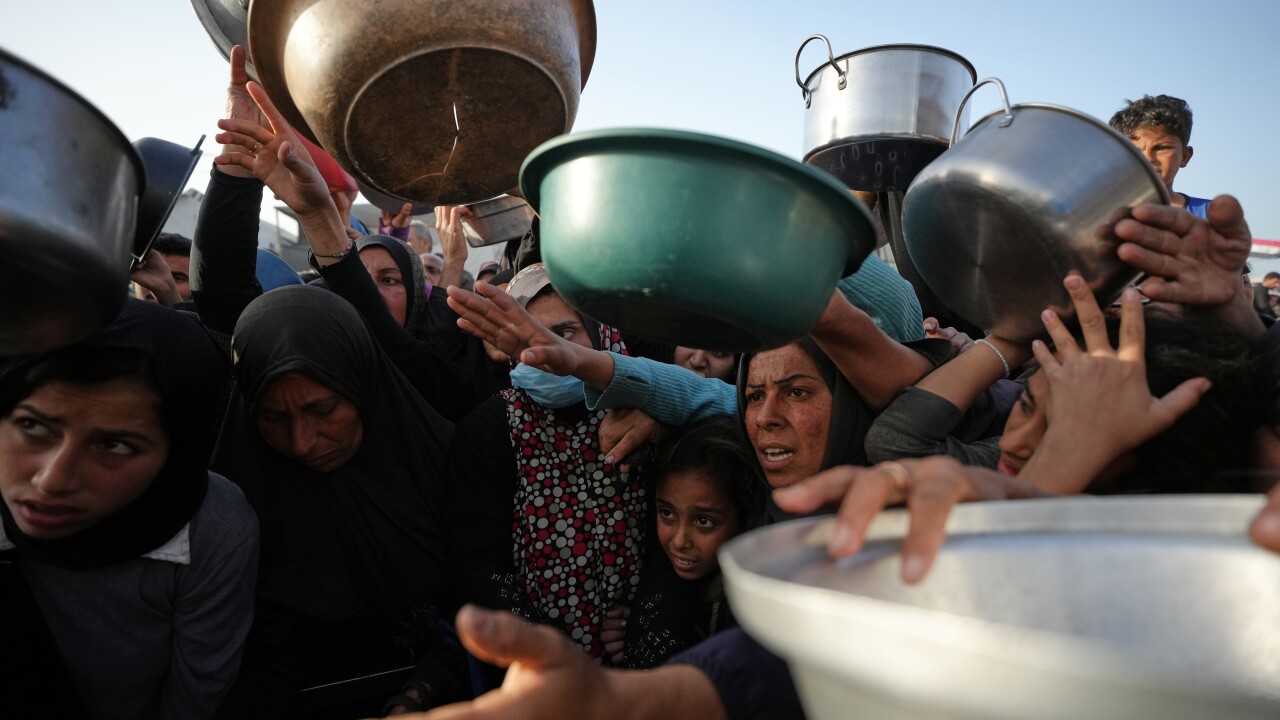


Dozens of foreign delegations are expected to participate in the inaugural meeting of President Donald Trump’s “Board of Peace” on Thursday, but the long-term prospects for the Board – and its broader mandate to secure long-term peace between Israel and Palestinian officials in Gaza – remain unclear.
48 nations will send representatives to Thursday’s meeting, a senior Trump administration official told Scripps News; Israel will participate, as will several Arab countries previously involved in U.S. efforts to broker a ceasefire in Gaza including Qatar, Egypt, Saudi Arabia and Turkey.
Several other nations far removed from conflicts in the Middle East but friendly with the Trump administration are also expected to participate, from Italy to Argentina to El Salvador to Hungary. But some prominent U.S. allies will not be there, as nations continue to debate whether to join the unique and controversial venture.
Mexico’s President Claudia Sheinbaum said her country was declining to join the board citing a lack of involvement from Palestinian leaders, while the Vatican similarly declined an invitation – suggesting such multilateral peace efforts would be better coordinated through the United Nations.
“One concern,” Holy See Secretary of State Cardinal Pietro Parolin said, “is that at the international level it should above all be the UN that manages these crisis situations. This is one of the points on which we have insisted.”
The White House called the Vatican’s announcement an "unfortunate decision.”
“I think it's deeply unfortunate. I don't think that peace should be partisan or political or controversial. And of course, the administration wants all those who were invited to join the Board of Peace to join,” White House press secretary Karoline Leavitt said. “This is a legitimate organization where there are tens of member countries from around the world, and we think that's an unfortunate decision.”
The president too has played-up the initiative, describing it as “the most consequential international body in history” on Monday and promising “we’re going to have all world leaders.”
“Since the President and his world-class team ended the war between Israel and Hamas last October, we have maintained the ceasefire, delivered historic amounts of humanitarian aid, and freed every single living and dead hostage,” White House spokeswoman Anna Kelly told Scripps News in a statement Wednesday. “The Board of Peace will continue this historic success and prove itself to be the most consequential international body in history.”
RELATED STORY | Netanyahu signs on to Trump’s Gaza peace board as some allies decline
During the meeting – set to take place at the “Donald J. Trump Institute of Peace” – Trump will serve as chair and deliver opening remarks, according to a senior administration official, and will be followed by other administration officials who will speak to various lines of effort. Among topics expected to be addressed are efforts to increase humanitarian assistance within Gaza, developments surrounding the National Committee for the Administration of Gaza (NCAG) and the status of the International Stabilization Force (ISF), designed to help provide security, train a new Palestinian police force, and oversee the demilitarization and redevelopment of the Gaza Strip
In addition to the president, Secretary of State Marco Rubio, Special Envoy Steve Witkoff, Trump’s son-in-law Jared Kushner, UN Ambassador Mike Waltz, High Representative for Gaza Nickolay Mladenov and former UK Prime Minister Tony Blair were all expected to deliver remarks, officials said. It did not appear any officials representing Palestinian leadership or the Gazan people were set to participate in the meeting.
Trump will announce pledges of more than $5 billion from member states towards Gaza humanitarian and reconstruction efforts, according to Leavitt, and the commitment of “thousands of personnel to the international stabilization force and local police to maintain security and peace for Gazans.”
And while Thursday’s convening was expected to focus solely on the situation Israel and Gaza, the president has repeatedly stated his intention that the Board’s work extend far beyond that conflict.
“We're working in conjunction with the United Nations,” Trump told reporters aboard Air Force One on Monday. But he noted that, “I think it's gonna go far beyond Gaza, and I think it'll be peace all over the world.”
THE BOARD OF PEACE | Trump rolls out his Board of Peace at the Davos forum, but many top US allies aren't participating
Thursday’s meeting comes as geopolitical tensions remain high elsewhere in the world; another round of trilateral talks between the U.S., Russia and Ukraine concluded Wednesday in Geneva without a breakthrough, meanwhile the U.S. continues to amass military assets in the Middle East amid growing escalations with Iran.
And while the ceasefire Trump brokered between Israel and Hamas is mostly holding thus far, questions remain over progress towards “phase two” of the peace agreement – which necessitates Hamas’ demilitarization and the revitalization of the Gaza strip
Hamas militants continue to say they will not fully disarm, despite the requirement in the president’s peace plan, and Israel is reportedly exploring restarting its military campaign in the region.
Nonetheless, a senior U.S. official pushed back on the notion that progress on the Gaza peace plan had stalled.
“Nothing could be further from the truth,” the official said. “We are under no illusions on the challenges regarding demilitarization, but we have been encouraged by what the mediators have reported back.”
